Sponsor

Showing posts with label graphs. Show all posts

Monday, November 3, 2014

Is My Dog Fat?

If I have to ask if my dog is fat, the answer is probably yes. Most pet dogs in the USA are fat, and overweight pets are so common now that many people don't even recognize what a healthy bodyweight looks like. It's a lot like humans, if you look at a class full of mostly overweight kindergartners, your kid looks totally normal. Even if he has a bit of a beer belly. That's just baby fat. He'll grow out of it.

Brisbane was a fat puppy because I didn't know what a fit dog should look like. He was basically tube-shaped with no definition between his ribcage and abdomen. At this point in his life he was free-fed, I would put food down for him and let him eat until he stopped.

At the time I did not realize how bad Brisbane's conformation was, or how hard it was on his body to carry all that extra weight. When I found out that he had spinal issues, I put him on a diet and slimmed him down.
Photo by Erin Koski
Because he has so much potential for joint pain and injury, I keep Brisbane very trim. This ensures that he carries as little weight as possible, which helps him move easier and decreases wear and tear on his joints. Just like humans, dogs feel a lot better when they aren't wrapped in extra poundage.

Here is Dr. Sophia Yin's explanation of body condition scoring, the way veterinarians objectively assess how fat or skinny a dog is. I've met plenty of people who think "fat" is relative when it comes to dogs, it really isn't.

A fit dog's skeletal structure should be easy to feel, and somewhat easy to see. Brisbane has an abdominal tuck when viewed from the side, his ribcage is significantly lower than his belly. I can run my hands down his back and feel each rib and vertebrate, his hips and leg bones. If he were a shorthaired dog like a boxer, I would keep him skinny enough to see at least a rib or two. Briz has plenty of muscle to prevent his spine and hip bones from becoming visible.

Ulysses is severely lacking in muscle tone, I can feel his spine poking up sharply when I pet him. This doesn't mean he is skinny, though. When he came out of the shelter he had visible ribs and bit of a potbelly due to adequate food, no exercise, and no muscle to feed. As we work on building muscle, he is gradually changing shape.

A body condition scoring chart and a critical eye is the best way to evaluate a dog's weight and condition, but I see so many obese dogs that I made a flowchart. My fellow dog nerds complained that my chart doesn't differentiate between fit and too-skinny, but I only made it to answer the one question, "Is my dog fat?"

Thursday, August 14, 2014

The Twilight Zone

Last week Ulysses and I met someone from a local rescue who hoped she could help with his behavior issues. Unfortunately, I knew we wouldn't be able to work together the moment she said that my chihuahua was exhibiting dominance by begging for treats. Veterinary behaviorists, accomplished trainers in many fields, and pretty much the entirety of the dog training community would agree that Ru begs before treats because he has been rewarded for doing so in the past. Only TV dog trainers and those who want to set dog training back thirty years would insist that my chihuahua begs for treats because he believes himself to be above me in our pack structure, and would automatically cease this behavior if he learned his proper subordinate place relative to myself.

Suffice to say I won't be reverting to any outdated beliefs in the mythical pack structure of wolves in order to work with Ulysses. I'll be sticking with the principles of behaviorism, which work on everything and not just dogs.

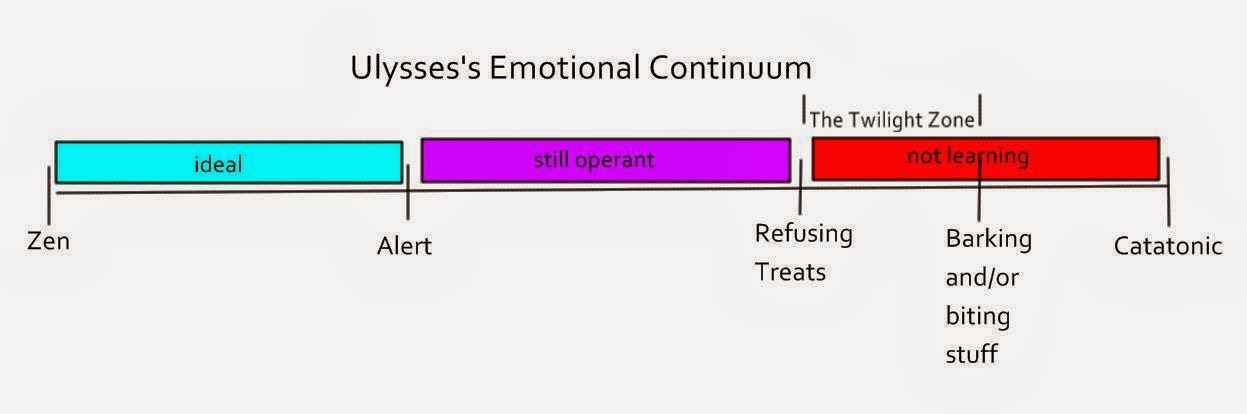
Working with Ulysses is fascinating because he is so very different from Brisbane. I am fortunate to have a dog who broadcasts his emotional state so effectively, it's easy to tell when Brisbane is too excited or stressed to learn because he is hysterically screambarking. I made a graph to illustrate this:


It is worth pointing out that Brisbane will still take treats even when he is having hysterics. Ulysses is much more subtle, and he acts deceptively calm almost all of the time.


At a certain point Uly will lunge and bark at exciting things, but well before that he gets stressed enough to stop taking treats. He is probably giving other signs of his stress level as well, but for now the only way I can tell when he crosses over into the Twilight Zone is when he stops taking treats.

On Sunday Uly and I went for a nice walk on the trails at a very low traffic time of day. When we were walking together on the empty trail, he stayed in the operant zone. Passing other people on the trail puts him into the Twilight Zone. Passing another heeler/Australian shepherd mix running alongside a bicycle put him all the way up to biting stuff, and kept him excited enough to pull on the leash instead of walking nicely.

Ulysses seems to be naturally good at loose leash walking, but I would like him to check in rather than just exist at the end of a slack leash. Fortunately, Uly's default behavior seems to be checking in, so when he does hit the end of the leash I just wait patiently for him to come back and look at me. I give him a treat, and we keep walking.

The exception to this pattern was when we saw the other dog run past. Uly ran to the end of the leash and stayed there, staring down the trail in the direction she had gone. When he finally came back to check in, he took the treat I offered and then dropped it. As soon as we resumed walking, he hit the end of the leash and leaned against it again, so I waited for him to finish watching down the trail and come back to check in. The fourth time we did this, Uly finally ate his treat, and when we resume walking he was again relaxed and walking nicely on a loose leash.

I like training with food rewards for a variety of reasons, Brisbane is incredibly food motivated and it's a great way to get his attention off an incoming dog or passing UPS truck. Ulysses is less motivated by tasty treats, but food rewards are just as important for him because they are a useful barometer for his stress level. Uly's response to food is currently the only way to tell whether he is truly relaxed and happy, or whether he has crossed over into The Twilight Zone.