Sponsor

Showing posts with label head halter. Show all posts

Wednesday, July 20, 2016

Product Review: Holt Head Collar

This Holt Head Collar is often sold under the Top Paw and Walk n' Train brands. It features an adjustable slide lock on the bottom of the noseband, foam padding on the top of the noseband, and a safety strap that connects to the dog's regular collar. This collar is currently available in four colors, including pink!
Top Paw head halter
Photo by Erin Koski

I picked this head halter up at a thrift store for less than a dollar, assuming it to be another Halti knockoff. As it turns out, this Holt collar has a couple of features that the Halti lacks.

You can't really tell from the picture, but the inside of the noseband is padded with foam. This seems to make it rub less on the top of the muzzle, and also provides a little bit of shock absorption if the dog makes a sudden move.

One of the big features of the Gentle Leader headcollar is the slide lock on the noseband that limits how wide it can open. There is nothing to limit the noseband on the Halti, however it does have cheekpieces that help keep the band in place. The Walk & Train head halter offers the best of both worlds, with cheekpieces to help hold the noseband in place, and a slidelock that can limit how far it opens.

Pros: More comfortable than other head halters we've tried. Padded noseband comes standard. Unique combination of features allows for a secure and comfortable fit.

Cons: Adjustment features make it easier to misuse the collar, too tight and the dog won't be able to pant effectively.

Bottom Line: I had grabbed this head halter out of a drawer because I needed one in a pinch, but it has turned out to be a favorite.

Monday, August 3, 2015

Bad Idea: Why Can't I Use a Flexi Leash With a Gentle Leader?

Working at a doggy daycare, I see a lot of egregious misuse of dog gear. Some are merely self-defeating, others are actually dangerous. My least-favorite gear combo is a retractable leash attached to a head halter.
Not pictured: the leash I'm standing on, attached to Brisbane's collar for safety.
Photo by Erin Koski

Why Is This a Bad Idea?
A Halti, Gentle Leader, or other head collar with the leash attachment at the front of the dog's head, has a surprising potential to cause harm. These tools require very little strength on the part of the handler because they control the dog's head. This is at the very end of his spine, obviously. A head collar is intended to teach loose-leash walking, mostly by making pulling on the leash uncomfortable for the dog.

A retractable leash, like the perennially popular Flexis, works by means of a spring inside the leash casing. This spring applies continuous tension to a wheel in order to keep the leash taught and off the ground. While it does not apply a lot of force, the entire reason retractable leashes retract is because they exert continuous leash pressure.

So the first problem with the Flexi/headcollar combo is that the leash puts continuous pressure on the headcollar and therefore the dog's face. They can't really walk on a loose leash unless the brake is locked. This is often uncomfortable for the dog, and habituating them to leash pressure is the exact opposite of teaching them to walk nicely on a leash.

The second problem with this gear combo is that retractable leashes tend to be longer than fixed leashes. The longer the leash, the more speed a dog can build up before he hits the end of it and comes to an abrupt stop. Hitting the end of a 15' leash at top speed on a neck collar, where the pressure is closer to the center of his spine, is bad enough. Hitting it on a head halter can cause serious neck injuries and even be fatal in certain circumstances.

Good Idea
I would love to see the general public give head halters a little more respect. It needs to be used with very light pressure, otherwise you're torquing your dog's neck around all over the place. I like to use a 4' leash to limit how far my dog can get from me, and remind myself that we are using a training tool so I need to stay attentive and hopefully redirect my dog before he tries to run somewhere.

I'm not a big fan of Flexi leashes in most public spaces, but I still own and use several of them because they are just so convenient is certain outdoor spaces where it is acceptable for my dogs to be 15' away from me. I always attach a Flexi or any other long leash to a harness. That way, when my dog suddenly sees a squirrel, or hears a poorly-timed firework, or any other unplanned event causes him to suddenly speed off without warning, he won't get hurt when he hits the end of the leash. Not every dog is prone to bolting, and it may not happen very often, but I still think it's wise to be careful. If my dog suddenly finds some reason to run to the end of his leash at top speed (deer, mail carrier, gunfire, zombie attack, clowns) there's no chance he's going to injure or break his neck.

Sunday, September 28, 2014

Product Review: Gentle Leader Head Collar

The Premier Gentle Leader is a head collar, or head halter, made by PetSafe. The basic nylon webbing version comes in five sizes and nine different colors to fit dogs of all sizes. The deluxe version features a fleece-lined nose loop with a ribbon overlay, it comes in three colors and includes a matching leash.
Photo by Erin Koski

The Gentle Leader is probably the easiest to find head collar, and might be the easiest to use. I find them at thrift stores on a regular basis, and currently own three or four. Many dogs really hate wearing a head collar, but for the dogs that don't mind, this can be a really excellent bandaid for pulling on the leash.

The Gentle Leader became popular and easy to find in stores in the late 1990's, but it had been around for at least a decade before that under a different name. The Promise Collar was touted as a "natural" training system designed to work with the dominance-based pack structure believed to be the key to dog training at the
time. As the science of behaviorism began to influence dog training, and reward-based positive training surged in popularity, the Promise Collar was rebranded as the Gentle Leader. The Authority Loop became the Leader Loop, and the training tool was no longer intended to dominate subordinate pack members.
Briz is not a fan/

I sort of love and hate this collar. I love that I haven't paid more than a dollar for any of the many I have owned and given away. I love that this collar is incredibly adjustable, one side of the neck strap is a fixed length and the other side as well as the nose loop can be adjusted all the way down to nothing, so Brisbane can wear a medium, a large, and possibly even an extra large Gentle Leader. I love that there are only two loops, so it is relatively simple to put on.

At the same time, I hate that most dogs fight this collar even when it has been carefully introduced. I hate seeing long leashes and even retractables attached to these. I hate seeing dogs back out of them at the worst possible time, and I hate how pretty much everyone has them sized wrong. The neck loop is supposed to be very tight, so tight even a single finger can't be slid under it. Most dogs hate this, and most of their owners do, too. The thing is, the neck strap needs to be super tight, sitting right up behind the ears, in order to keep the nose loop in place. If the neck strap is too loose, the nose loop can slip off, and most people respond by making the nose loop too tight.

A correctly-fitted Gentle Leader should fit tightly around the neck, but very loose around the nose. The plastic adjuster on the nose loop should be positioned so that it is barely not loose. Most dogs will not be able to back out of the collar when it is super tight, but I use a martingale or slip collar as a backup in case they do manage to escape the Gentle Leader.

Pros: Easy to find, easy to use, and each size fits a wide range of dogs. Definitely the least-confusing and most user-friendly head collar.

Cons: Most dogs hate it at first, many continue to hate it even when properly introduced. Difficult to adjust correctly, and may be uncomfortable for the dog when the neck strap is tight enough. No backup or safety feature in case dog backs out of collar. Unlined nose loop tends to rub marks on dogs who wear the Gentle Leader often.

Bottom Line: There are head collars I like better than the Gentle Leader. There are head collars that many dogs like better than the Gentle Leader. However, this is still my best bet for introducing people to the whole concept without overwhelming them with a tangle of straps.

Tuesday, September 23, 2014

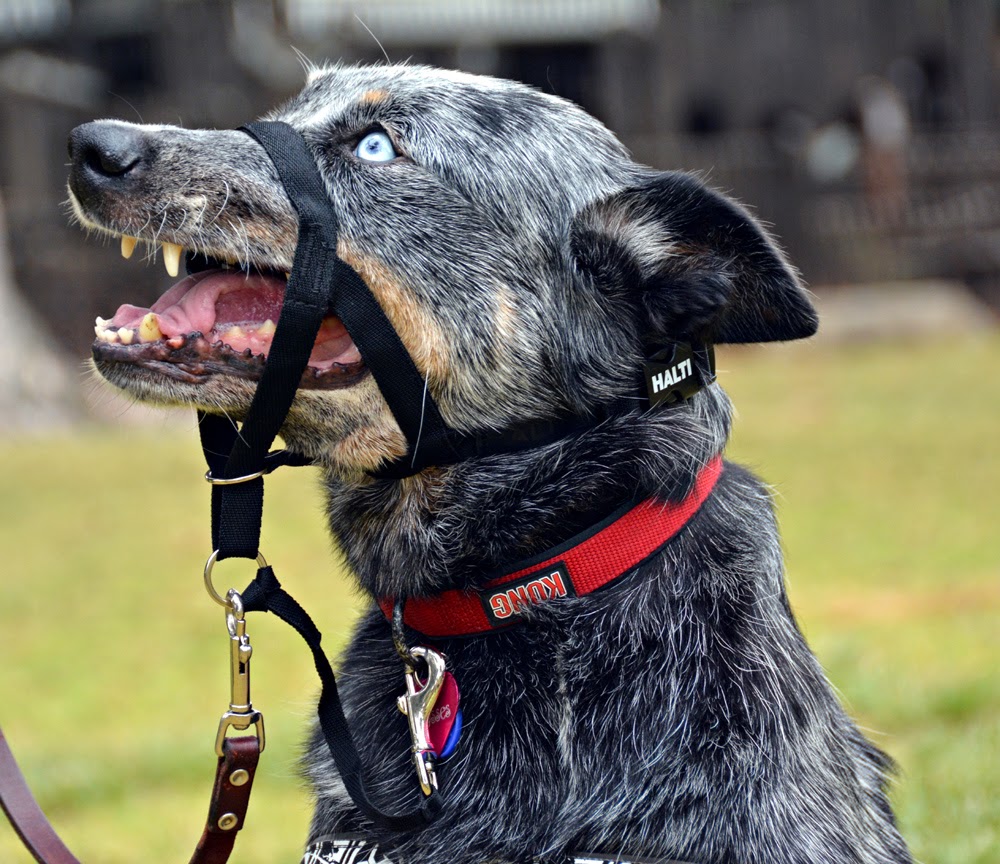
Product Review: Halti Head Collar

The Halti, by The Company of Animals, is a head halter or head collar. It comes in six sizes to fit nearly any dog, and is usually made from black nylon webbing. Haltis can occasionally be found in red, and I swear I've seen them in blue and brown at some point in the last 20 years.

Um yes, that's a nice flattering expression Uly.
Photo by Erin Koski
This is the first head collar I can remember seeing in a pet store, way back in the 1980's. It would be years before I would see any other type, and for a long time I thought "Halti" was a synonym for "head collar".

The safety strap on the Halti is a relatively new addition, the original didn't have any sort of backup system if the dog managed to pull out of the collar itself. I appreciate this feature because I have seen many dogs escape from these thing. Some companies claim that no dog should be able to escape from a properly-adjusted head collar of their brand, but these ignore dogs like sighthounds and also Brisbane, who have heads smaller than their necks. No matter how tight I make the neck strap of the Halti, Brisbane can still back out of it when he really wants to. I usually use a second leash or a Euro lead attached to a harness as a backup for a head collar, the safety strap is still useful though.

The nose loop on the Halti sits a bit lower on the dog's muzzle than some other head collars. This makes it more comfortable for some dogs. So far the Halti is the head collar Brisbane is least unhappy wearing. Given that it is often easier for dogs to accept, it was also the first I tried to use with Uly. After spending a couple of weeks teaching him that having the head halter on his face meant happy fun treat time, I tried to take him for a walk in it. Aside from occasionally pawing at his face, Uly was fine until he went into a death roll two blocks from the house. While thrashing wildly he managed to get the nose loop all the way down to the tip of his nose, and then caught or twisted it such that it cinched tight. The loop pinching the tip of his nose made him sneeze continuously and thrash even harder until I got the halter unbuckled and pulled it off. Since the other end of the leash was attached to his harness, Uly was still safe and we were able to resume our walk immediately.

Pros: Soft and gentle on delicate faces. Sits well away from the eyes to help protect delicate facial structures. Seems to be more comfortable that other popular head halters for some dogs, including Brisbane. Closes the dog's mouth when pulled tight, which can be useful when managing a dog that may bite. Safety loop helps keep the dog safely leashed even if they manage to slip out of the Halti.

Cons: Easier to escape than some other head halters. Does not come in fun colors. Low placement of nose strap can lead to slightly alarming nose entrapment on certain klutzy ridiculous dogs.

Bottom Line: What makes for a happy head halter experience for one dog will not necessarily make for a happy head halter experience for another. The tradeoff for the kinder, lower, more comfortable nose loop is that the Halti is easier to escape and can somehow cinch down on the end of the nose in somewhat bizarre circumstances. It's still one of the two easiest to find head halters though, and I have no plans to stop using or recommending it anytime soon

Monday, March 17, 2014

Painless and Fun Loose Leash Walking

I started teaching Brisbane to walk nicely on a leash when he was a baby puppy. This was easy because he had never had the chance to develop a habit of pulling. Walking with a loose leash is healthier for both of us, it saves his neck and throat along with my arms, shoulders, and back. When he is excited, Briz still needs to be reminded that he knows how to walk nicely. He is also clever enough to test whether the person holding his leash knows that he knows how to walk without pulling. Brisbane will pull like a sled dog if he thinks he can get away with it.


I feel that the trick to loose leash walking is to teach something other than "Don't pull." Teaching a dog to do something is a lot easier than teaching him to not do something. It's not unlike the way it is easier to think about purple cows than it is to not think about purple cows.

I've also taught several foster dogs how to walk nicely on leash, and the first step is, of course, don't let him do that. I think that teaching loose leash walking is more important than going for a walk, so for a few days that is all I am going to try to accomplish. It doesn't matter how far we get, or if we even make it out the front door.

I like clicker training dogs to walk on leash because clicker training makes pretty much everything easier. Whether I am using a clicker or not, I want a tight leash to be a signal to the dog. Every time the dog hits the end of the leash, I want him to be aware.

For dogs that have a long-standing habit of pulling on leash, I might need to use a tool like a head halter, a no-pull harness of some sort, or even a prong collar. For a dog that is very used to pulling on a flat collar or a choke chain, I like to use a harness. A body harness can encourage a dog to pull by taking the pressure off his neck and distributing it across his chest. However, a dog that is unused to wearing a harness will be unfamiliar with this sensation, and for a brief time I will have the opportunity to teach him that it means something. Different dogs respond differently to the various no-pull tools, the key is to find something the dog will pay attention to without fighting or feeling distressed. The plan is to wean him off of this cue as soon as possible.

Once I've got the dog fitted with the right collar or harness, it's time to start training. For some, this begins in the livingroom or the yard because outside on the sidewalk is just too exciting. I start moving and encourage the dog to come along, and then as soon as he hits the end of the leash he gets a click or a 'yes!' or a 'whee!' as I run backward while offering a treat. He very quickly learns that hitting the end of the leash means he should turn around because I am about to become very exciting while handing out food.

This training will continue for several days, moving from indoors to the yard and finally the sidewalk or park. We often don't make it more than a few feet from the driveway, and the dog might eat his entire dinner, one kibble at a time, as rewards for running back when he hits the end of the leash. Going for a walk can be very exciting, sometimes too exciting for the dog to monitor his own behavior. The trick is to get him very solid on this leash-pressure-means-check-human concept before moving to a more exciting environment.

When I can dedicate several days to cueing and rewarding the dog every single time he hits the end of the leash, the payoff is a dog that is sensitive to leash pressure and constantly aware of me. It seems like getting rewarded for hitting the end of the leash would cause a dog to pull more, but it has the opposite effect. I can quickly reduce the excitement and reward for hitting the end of the leash, and still have a dog that slows down and looks back insead of pulling ahead.

Thursday, March 13, 2014

Comparison: Head Halters

There are a lot of different head halters out there, and I only own three of them. I don't actually use a head halter on any of my dogs, for various reasons. Josie is too old and lame to generate any sort of pulling power. Ru is such a featherweight that I'm not actually sure if I would even notice if he pulled on the leash.

I have used a head halter on Brisbane in the past, but I've never successfully conditioned him to enjoy wearing one. Some dogs fight and paw at their faces when wearing a halter, Brisbane just gives up at life. This is a useful enough feature that I do occasionally put one on him when I need him to just lay there in a pile of despair. I have been told by more than one veterinarian to avoid using head collars on dogs with spinal issues, and they have the potential to hurt the neck of a healthy dog too. I only use a 4' or shorter leash with a head halter, and have to stay attentive and keep the dog from running to the end of the leash and jerking their neck.

Because Brisbane is incapable of looking animated or even lifting his head off the ground when wearing them, Josie is modeling all of my head halters. She is significantly bigger than Briz, but these things fit a pretty decent range of sizes.

Photo by Erin Koski
This is the Gentle Leader. by Premier. It comes in a variety of colors and five different sizes. The Gentle Leader uses a simple design with a loop that goes around the nose of the dog, and another that fits around the neck. The neck loop can be adjusted down very small, and the nose loop is the same width for most of the sizes. This means that a large Gentle Leader can still fit a relatively small dog, which makes them rather versatile. Premier also makes a Deluxe version with a padded noseband.

My experience has been that dogs hate the Gentle Leader more than other headcollars. Josie definitely pawed at it much more during our photo shoot, and it tends to leave marks on dogs with sensitive skin. The Gentle Leader doesn't really have a built-in safety measure in case of escape. The neck loop is supposed to be fitted tightly enough that it can't slip over the dog's head, but Brisbane's neck is fatter than his head and no amount of tightening would prevent him from backing out of this thing if only he could muster the willpower. I would definitely recommend using the Gentle Leader with the leash clipped to a martingale or slip collar because emergency backup measures are awesome.

Photo by Erin Koski
This is the Halti, by The Company of Animals. It is the first headcollar I can remember seeing as a kid. The noseband of this halter sits further down than the Gentle Leader, and I thinks that's why many dogs tolerate it better. This is a Halti sized for Brisbane, but you can see it still fits Josie. When the Halti is pulled tight it closes the dog's mouth, this can be helpful for dogs that bite or attempt to eat things off the ground.

I really appreciate that the Halti has a safety strap with a small clip to attach to the dog's collar. The Halti isn't intended to be as tight around the dog's neck as the Gentle Leader, and this extra safety strap is particularly reassuring when attached to a martingale or slip collar.

Photo by Erin Koski
This is the Canny Collar, and it is a bit different than most head halters because the leash attaches in the back, behind the dog's head. I haven't tried actually using this one yet, but Josie was significantly less unhappy about wearing it. My favorite thing about the Canny Collar is that it does not twist the dog's head around at all. From a training perspective this could be a disadvantage because I would not be able to force the dog to look up at me. However, it seems to be significantly safer for the average dog owner who just wants to go for a walk without their arm getting dislocated.
Photo by Erin Koski

The Canny Collar is built on a flat buckle collar, and this again could be a problem for dogs who back out of collars. One of the neat features about the Canny Collar is that the nose loop can be slipped off and secured around the dog's neck for off-leash play or practice walking on a flat buckle collar.

This would definitely be the first head halter I would recommend to someone who wants to walk and isn't focused on training. I would also probably recommend the Infinity Lead, although I haven't yet found one in a thrift store so I have yet to try it myself. The Infinity Lead also attaches to the dog's collar as an emergency backup measure.

The Snoot Loop, Sporn Halter, and Comfort Trainer are a few more head halters I haven't actually played with yet, but the ones pictured here are the most common and easiest to find. I think the rear-attaching halters like the Canny Collar are becoming more common, something I'm very glad to see. Whether head halters count as positive or negative training equipment probably counts a lot on the dog and handler, but they need to be used carefully to avoid injury.