Sponsor

Showing posts with label Ulysses. Show all posts

Thursday, January 8, 2015

Good Dogs Growl

My car has a dipstick that allows me to check the level of oil in the engine, it also has a light on the dashboard that can warn me that there is something wrong. This is very important, without these warning systems I wouldn't know something was wrong until my engine burst into flames. It's really nice to have a way to gauge the state of the engine so I can do whatever is necessary to prevent things from getting to the point of disaster.

Photo by Erin Koski
Dogs have a warning system sort of like that, but instead of bursting into flames, they bite. Some dogs need very little maintenance and can go a long, long way without needing intervention. Some dogs are the equivalent of a used Alfa Romeo and need constant management. Instead of dashboard lights and dipsticks and funny noises under the hood, a dog's warning system consists of body language and vocalizations.

One of the least subtle warnings a dog can give is a growl, an impossible to ignore message that something is very wrong and needs to change. A growl means "Careful, I'm about to reach my limit and I will bite you if you don't back off."

Unfortunately not everyone sees it that way. For some people, growling is a sign of disrespect. They take it as a threat, rather than a simple statement of fact. Lots of people punish dogs for growling. "How dare you do that to me!" They teach their dog that bad things happen when they growl, and then declare that he knows his place when he will tolerate all sorts of touching, hands in his food bowl, and any other sort of rude behavior on the part of the human.

The thing is, teaching a dog not to growl doesn't teach him respect, it just unplugs the dashboard lights and throws away the oil dipstick. It does absolutely nothing to change the point at which the dog will bite, it merely erases any warning that the limit may be approaching.

People who disconnect or just ignore dashboard warning lights, and refuse to check their oil, occasionally find their engine seizing or bursting into flames during rush hour traffic. A dog that has been taught not to growl or show teeth will sometimes bite seemingly out of nowhere. Taking away the early warning system did nothing to change the point at which very bad things happen.

Dogs have limits. They can only handle so much stress before they will try to defend themselves. We can change those limits by gradually teaching the dog to feel relaxed and happy, or at least less stressed by his triggers. Dogs aren't robots, mindless automatons, or minions. They are intelligent beings capable of communicating their state of mind. We owe it to them to listen to what they tell us.

I believe my foster dog Ulysses was punished for growling at some point in his life. This is what made him an extremely unsafe dog and ultimately resulted in his death. He was always a very nervous dog, but likely felt that it was unsafe to growl and warn me when he was reaching his stress limit. Instead, he silently became overwhelmed and then lashed out very suddenly. It was never his fault, he was a sweet, beautiful, wonderful dog. He was simply taught that communicating was unsafe.

When a dog growls, the correct response is to fix the situation. Back off and get some distance between the dog and his stressor. Find ways to help him develop positive associations with the things that make him growl. Fix the underlying fear or anxiety instead of hiding it.

Good dogs growl.

Monday, January 5, 2015

Goodbye Ulysses

We said goodbye to Ulysses yesterday. Despite a whole lot of training and behavior management, he was continuing to bite very hard without warning. Ultimately we decided that he was not going to be a safe dog to place in an adoptive home, or any home. He was a sweet, wonderful, beautiful dog all the rest of the time, and I'm glad I was able to give him so many months to enjoy being a spoiled dog. He was very loved.
Photo by Erin Koski

Wednesday, October 8, 2014

Product Review: Kong-brand Reflective Harness

The Kong Reflective Harness is a Roman-style harness with a padded chest plate. It features heavy duty metal hardware and reflective stitching. It comes in four colors and four sizes to fit dogs with chests 12-38" around.
Photo by Erin Koski

The Kong-branded products not shown on the Kong Company website appear to be exclusive to Petsmart, which seems kind of weird. They are advertised under the slogan "tough enough to be called Kong" and range from collar, leashes, and harnesses, to beds, crates, and even life jackets. I'm not totally comfortable with the idea of products bearing a familiar and trusted brand name without actually being acknowledged by that company. Several consumers also appear to be confused, as bad reviews for this product often cite a "lack of durability" because their dog chewed through it. Harnesses aren't chew-proof....

This is a very nice harness, though. While it's not actually a crash-protection harness, it is overbuilt and extremely strong compared to the average walking harness. The leash ring is too big for the clips on my Lupine leashes, an issue I haven't had before. The harness adjusts around dog's neck and chest, but the front center section with the chest pad is a fixed length. This makes the Kong Reflective Harness slightly less adjustable, and it may not be a great fit for weird-shaped dogs. Unlike the EzyDog Chest Plate Harness, the chest plate on this one is flexible and doesn't stab my dog in the neck.

Pros: Extra strong and tough. Reflective stitching increases visibility. Metal hardware is durable and built to last.

Cons: Not terribly adjustable and extra large hardware limits which leashes can be used. Wide chest plate may rub the inside of the front legs or damage the hair on some dogs.

Bottom Line: It's a nice harness and a lot of people like it, but it isn't going to prevent injury in an actual collision. It works great for Ulysses.

Saturday, August 16, 2014

Crate and Rotate

I am currently managing the issues between Brisbane and Ulysses, but for the first couple of weeks after I got bit, I had them on a crate and rotate routine.

What is "Crate and Rotate"?
Crate and Rotate is a management technique for keeping two dogs in the same house separated. It is most useful for preventing fights between dogs. 

How does it work?
The idea is that the two dogs are never unrestrained in the same space at the same time. When one dog is a liberty in the house, the other is contained in a crate or xpen, behind a door or baby gate in another room, or outside. The dogs take turns being loose in the house and being contained. At my house I generally had either Brisbane or Ulysses in the crate in my living room. I also have two crates in the bedroom, a baby gate across the doorway of my office, a bathroom, and a fenced front yard in which to stash dogs.

What are the benefits?
Crate and rotate allowed me to keep both Brisbane and Ulysses in my house without giving them the opportunity to fight. After Ulysses bit me, I initially felt that I could not keep him in my house because I could not prevent him from fighting with Brisbane. Our options were to find him another foster home (always in short supply) or euthanize him. While I discussed the issue with my rescue peeps, I decided to crate and rotate the dogs. Briz and Uly both like hanging out in crates, so the urgency to make a decision quickly faded. After a couple of weeks with incredibly tight management, I started to feel more comfortable working with him.

I now feel comfortable having them loose at the same time with close supervision, so I can let one out of the crate and put the other one in without worrying that they'll suddenly erupt into violence. I'm still doing a lot of crating though, as it allows me to use various food puzzle toys and long-lasting chews that could start a fight if both dogs were loose. To keep the boys happy about being crated, I always send them in with a chew, stuffed Kong, or at least a cookie. Sometimes I even toss something super exciting in there and then close the crate without letting them in, they stand there staring at that knuckle bone for a while and are extremely satisfied when I finally let them in to have a good chew.

What are the drawbacks?
When we're all just chilling in the living room, nobody minds being in a crate. It's a much harder system to maintain when I've just gotten home from work and want to greet everyone and let them out to pee. It's tough when someone has to wait their turn. Playing musical dogs was also sometimes irritating, since I was doing total separation I couldn't just let Ulysses out of the crate and send Brisbane in. Instead I would have to shut Brisbane in the bedroom, let Ulysses out of the crate and put him outside or in the office, then put Brisbane in the crate before letting Uly back into the house.

The biggest drawback to crate and rotate is that it is a management system that relies entirely on not messing up. One person who is always alert and vigilant might be able to pull it off flawlessly, but the reality is that there are two people living in my house, and sometimes we are tired or distracted, which increases the likelihood that someone is going to forget and let the wrong dog out at the wrong time. The risk for our situation was relatively low, since neither dog had hurt the other, their fights were not occurring on a daily basis, and they could at least tolerate each other almost all of the time.

If I was dealing with a much more serious aggression problem, the risk of messing up would be significantly higher. I would not be comfortable using crate and rotate to manage two dogs who were at serious risk of hurting each other, or two dogs who disliked each other enough to have a conflict every time they interacted. I would not use crate and rotate if I didn't trust my husband to maintain this system or just leave the dogs where I put them when I'm not home. I wouldn't use this system if I had children or other irresponsible/unpredictable people in my house.

Does Crate and Rotate Really Work?
This management system allowed me to keep Brisbane and Ulysses in the same house with a barrier between them at all times. It allowed both dogs to participate in family life without the stress of trying to deal with someone they don't like. It gave me time to analyze Ulysses and the bite he inflicted, and make a well-thought out decision instead of euthanizing him in despair. Crating and rotating also provided Brisbane and Ulysses with some much-needed structure and routine, and some practice at waiting their turn. It is currently allowing them to enjoy both the company of our family and high-value chew items at the same time, without fear that another dog might take their prize. Crating and rotating allows me to have training sessions with one dog at a time, and allows both dogs to have rambunctious play time without the other policing their activity.

While it's not the solution for every household dog aggression issue, crating and rotating is an excellent way to manage dogs that don't get along.

Thursday, August 14, 2014

The Twilight Zone

Last week Ulysses and I met someone from a local rescue who hoped she could help with his behavior issues. Unfortunately, I knew we wouldn't be able to work together the moment she said that my chihuahua was exhibiting dominance by begging for treats. Veterinary behaviorists, accomplished trainers in many fields, and pretty much the entirety of the dog training community would agree that Ru begs before treats because he has been rewarded for doing so in the past. Only TV dog trainers and those who want to set dog training back thirty years would insist that my chihuahua begs for treats because he believes himself to be above me in our pack structure, and would automatically cease this behavior if he learned his proper subordinate place relative to myself.

Suffice to say I won't be reverting to any outdated beliefs in the mythical pack structure of wolves in order to work with Ulysses. I'll be sticking with the principles of behaviorism, which work on everything and not just dogs.

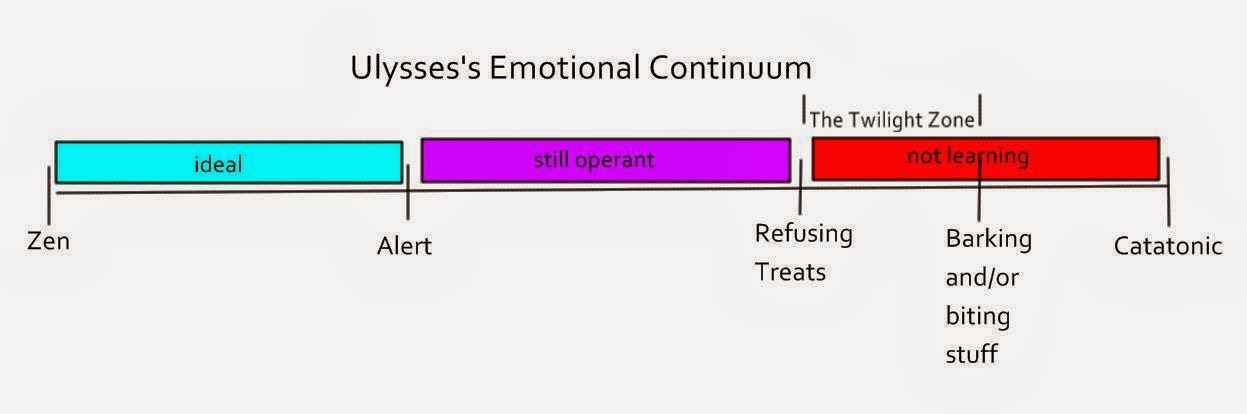
Working with Ulysses is fascinating because he is so very different from Brisbane. I am fortunate to have a dog who broadcasts his emotional state so effectively, it's easy to tell when Brisbane is too excited or stressed to learn because he is hysterically screambarking. I made a graph to illustrate this:


It is worth pointing out that Brisbane will still take treats even when he is having hysterics. Ulysses is much more subtle, and he acts deceptively calm almost all of the time.


At a certain point Uly will lunge and bark at exciting things, but well before that he gets stressed enough to stop taking treats. He is probably giving other signs of his stress level as well, but for now the only way I can tell when he crosses over into the Twilight Zone is when he stops taking treats.

On Sunday Uly and I went for a nice walk on the trails at a very low traffic time of day. When we were walking together on the empty trail, he stayed in the operant zone. Passing other people on the trail puts him into the Twilight Zone. Passing another heeler/Australian shepherd mix running alongside a bicycle put him all the way up to biting stuff, and kept him excited enough to pull on the leash instead of walking nicely.

Ulysses seems to be naturally good at loose leash walking, but I would like him to check in rather than just exist at the end of a slack leash. Fortunately, Uly's default behavior seems to be checking in, so when he does hit the end of the leash I just wait patiently for him to come back and look at me. I give him a treat, and we keep walking.

The exception to this pattern was when we saw the other dog run past. Uly ran to the end of the leash and stayed there, staring down the trail in the direction she had gone. When he finally came back to check in, he took the treat I offered and then dropped it. As soon as we resumed walking, he hit the end of the leash and leaned against it again, so I waited for him to finish watching down the trail and come back to check in. The fourth time we did this, Uly finally ate his treat, and when we resume walking he was again relaxed and walking nicely on a loose leash.

I like training with food rewards for a variety of reasons, Brisbane is incredibly food motivated and it's a great way to get his attention off an incoming dog or passing UPS truck. Ulysses is less motivated by tasty treats, but food rewards are just as important for him because they are a useful barometer for his stress level. Uly's response to food is currently the only way to tell whether he is truly relaxed and happy, or whether he has crossed over into The Twilight Zone.

Tuesday, August 5, 2014

Ulysses Returns

Almost three weeks ago, Ulysses was returned again. He was fighting with the other dog in the home, and showing some reactivity towards other dogs and people on a busy bike path. Between the fighting, barking, and lunging, the second adoptive family felt that Uly wasn't a good fit. I resolved to keep him for a few more weeks this time to better evaluate what type of home would be best for him. Although he has lived peacefully with two other dogs, he did fight with the dog in his second adoptive home, and he and Brisbane butt heads pretty regularly.

In fact, a little over a week ago Ulysses and Brisbane got into a fight in the yard. Though neither of them have been injured in any of their noisy disagreements, this time I got hurt. Brisbane wasn't ready to call it quits, so I grabbed him and walked away. Uly came after Briz and got my arm instead. He immediately bounced into a sit afterward, but I was left with a nasty puncture wound.

This is Uly's third bite, and that is very dangerous for a dog in rescue. Dogs with bite histories are a liability to place, I or anyone involved in his rescue could potentially be sued if he bites again in an adoptive home. For most dogs in rescue, a bite equals a euthanasia appointment.

So what's different about Ulysses? Uly remains an incredibly sweet dog despite his bite history. All three of the bites occurred in potentially preventable circumstances. Maybe just gut instinct too, he doesn't feel like a vicious dog.

The first bite occurred when the baby in the first adoptive family crawled near, or possibly on, Ulysses and took the toy he was chewing. The baby received a bite to the face, causing a bruise. The second bite occurred several weeks later when the adopter allowed both baby and dog to be on the floor with nothing between them. The baby crawled near Uly, the adopter says he stepped between them, picked the baby up, and pushed the dog out of the way. Uly turned around and bit his arm, causing a puncture and a single slice that required stitches. We believe the damage was largely due to Uly's broken lower canines.

This third bite is very different from the first two, I was actively moving out of Uly's space, and he was in the middle of a dog fight. Given his behavior immediately after the bite, I believe he was intending to bite Brisbane and not me. While this wouldn't be an ok bite for Briz to receive either, it makes a bit more sense than Uly randomly deciding to bite me.

So what is next for our boy? Prior to the most recent bite, we had been leaning toward finding Ulysses a home with someone who has worked with a reactive dog in the past. Immediately after the bite I was afraid that we were out of options because I could no longer keep Brisbane and Ulysses in the same house. However, Uly and Briz are both quite amenable to being crated, especially when there are stuffed Kongs involved. I've been able to keep the peace via the crate and rotate method, making certain there is always a door, gate, or other barrier between the two of them. This has worked extremely well, and has bought us some time to work out exactly what to do next, and to gather opinions from dog people near and far. When Uly is done with his current quarantine period in a couple of days, we'll be meeting with an evaluator for a local rescue, depending on her assessment we may meet with a highly regarded trainer in Los Angeles who works with aggressive dogs.

I can't say for certain what is going to happen to Ulysses, there is still the possibility that we will all conclude that he is too dangerous to be placed in an adoptive home. We may find really reliable triggers for his behavior, and then begin working with those triggers. All I can say for now is that I will do my best to see that Uly is happy and loved for the rest of his life.

Sunday, July 6, 2014

Last Day of Quarantine!

After today, this blue beast is finally allowed to leave the house again! First stop: the dog beach! Second stop: the grooming station at work. I cannot believe how much this dog sheds.
Photo by Erin Koski

Uly has been handling his ten-day quarantine period well, aside from shredding my fourth edition Van Norstrand's Scientific Encyclopedia/doorstop. This evening I gave him a rawhide chew and was pleased to see that he spent longer than Brizzy devouring it and didn't try to swallow any really big pieces. He has also successfully enjoyed Nylabones, the Urban Stick filled with peanut butter, and a variety of other toys without destroying them, so he's probably not going to be a serious chewer.

I am very pleased that Ulysses has become significantly more food-motivated since escaping the Orange County municipal shelter. This makes him much easier to train. He wants to sit and wait politely while I prepare his dinner, but he's so excited that he just has to dance. And Sit. At the same time.

A couple of days ago Uly picked up the plush Eiffel Tower from our latest BarkBox. Once he had the toy, he began to worry when Brisbane, Ru, or the cats were nearby. He has been gradually relaxing while staying here with us, but the other animals near his toy brought back the still posture, laid back ears, and wide eyes had had all the time when he was fresh out of the shelter. This kind of concern could turn into resource guarding if handled poorly, so we immediately started telling him what a good boy he was when the other pets were nearby. Right away he started relaxing and enjoying nibbling on the stuffy instead of focusing on the other animals.

Uly also doesn't like being led by his collar. At first I thought maybe he was unused to wearing it, but his shelter paperwork says he was wearing a collar when he was picked up as a stray. If I try to coax him up onto the couch or bed by pulling his collar, he drops to the floor and looks scared. I suspect he has been punished by being grabbed and shaken by the collar, so now he is afraid. We will be working on making collar touching a positive experience for him.

Wednesday, July 2, 2014

Welcome Back Ulysses!

Ulysses is back with us right now, his adoptive family returned him. This was a wise move, and we are very glad to have him back.
No idea what happened to that book.

Uly's adoptive family had a baby just under a year old. While Uly didn't show any signs of uncertainty about the baby while we were there, we also didn't get to see how he felt about the baby crawling on the floor. I did let the adopters know that he had growled at my dogs and cats one day while he was resting, and that he might feel uncomfortable being approached in that situation. I recommended a crate in the living room or wherever the family spent the most time, so he could have a protected resting spot where he felt safe.

Within a few days in his new home, Ulysses bit the baby. There was no damage aside from a small bruise, but it was concerning. We are told that the baby was crawling near him while he was resting, and that he probably gave signals that he was uncomfortable beforehand. The family said they still planned to keep him, and even took him to be signed up for their pet health care plan.

A few days ago he bit the man of the house. We're told that the baby was crawling near him, and that the man went to pick up the baby and pushed Uly out of the way, and then Uly turned around and bit his arm, leaving a puncture. While I wouldn't normally continue working with a dog that had a bite history, I feel there is more to this story.

First, Uly has an incredibly soft temperament. He is an absolute moosh. I have a very hard time believing that there wasn't some sort of severe and extremely scary correction involved in the original baby incident. The adopters seemed to be fairly competent in their dog training abilities, but I'm not certain they knew how to deal with behavioral issues. The average human would probably respond to the baby incident by screaming and punishing the dog, and then attempt to prevent future incidents by warning the dog not to do anything bad when the baby was nearby. This would actually just teach the dog that the baby is bad news, and that he is not safe around it.

We shared Dogs and Babies with the family, and recommended total separation via baby gates along with helping Ulysses understand that the baby means good things for dogs. Obviously neither of these things happened. The adopter tells us he went to push Uly out of the way, but Uly can't tell us how he was feeling at the time. Not everyone speaks Dog, and he may have been giving every possible signal that he was afraid. I honestly think he was afraid he was going to be hurt or killed when he bit.

Now that Ulysses is safely back in foster care, we're taking the time to learn more about him. The friend that picked him up and brought him back tells me that he wouldn't approach her husband even for bacon. He has been extremely friendly and affectionate with me, much more relaxed and playful than he was when he left. However, he is just as reserved as ever with my husband and male friends. Uly will greet them and hope for petting, but he isn't as happy and silly as he is with women. We haven't gotten any sort of fear or aggression response out of him. When he's off his ten day quarantine, we will be meeting lots of men and watching him carefully to see how he feels.

Was Ulysses labeled aggressive in the shelter because he was cornered by a man? We're not sure, but it seems likely. He's still the soft, gentle, sweet boy we thought he was. Now we need to find an adopter who is willing to respond to undesirable behavior with a quiet "uh-uh" or "what's wrong?" rather than "NO! BAD DOG!"

Saturday, June 7, 2014

Congratulations Ulysses!

Last week Ulysses and I drove way down to Orange County to meet the person who helped coordinate his rescue from the shelter. Uly had gone from unwanted and unadoptable to rescue superstar, with ten applications to adopt him within a week of him appearing on the rescue's Facebook and website.
Photo by Erin Koski
We met a couple of different families who had passed the approval process. With so much interest in this angelic boy, we were able to pick our favorite family. Ulysses is now named Cal, his new family has a red heeler named Tex. We loved how Tex's dad interacted with him, very patient and extremely positive. Tex's mom also adored him, and Cal liked sitting on her feet for petting.

The family also includes a baby and an older boy, around 8. He lamented that Tex only cuddled with his parents. Cal figured out right away this the kid was an easy person to beg for petting. I think he's going to end up bonding with the kids very nicely.

We don't know a whole lot about Cal's history. He came into the shelter as a stray, and acted like many things were very new. He had clearly never seen the ocean or a swimming pool before. He may never have been on a leash or in a house before, but he was so good-natured that he figured it all out very quickly.

Cal has been with his new family for a few days now. He is rapidly bonding with his new people, and warming up to them much faster than he did with us. It took him a week to get comfortable enough to play fetch with us, but he was playing ball with Tex and his new family on his second day home. Cal is in for a long life as a beloved family member, full of trips to the lake and snuggles on the couch. He's a naturally well-behaved dog, and he deserves such a wonderful life. I am delighted that I could be a part of his rescue and help him on his way home.

Saturday, May 24, 2014

Teaching Ulysses to Dance

Brisbane has a personal space bubble, when I move toward him he moves out of my way. In our small house I never run into him because he is constantly aware of where I am, and anticipates where I am going. Briz is very much a velcro dog, he usually stays very close to me, so we move through life together in a sort of dance.

Moving Brisbane from place to place is a bit like moving a buoyant object through water, a light touch sends it away. I can lead Briz by the collar, and position him very precisely with subtle cues.

Ulysses is another story entirely. He moves like a wet blanket, I touch him and he sort of folds around me. When I push him, he collapses around my hands. Pulling Uly's collar or harness mostly just makes him ooze to the floor.

I'm not sure now if Brisbane has always had his personal space bubble, or if it is something I taught him as a puppy. Before Uly arrived I had thought it was an innate quality of herding breeds, minus some very squishy German Shepherd dogs. Now I suspect it is something that must be taught, but herding dogs probably learn it better and with more finesse than insensitive gundogs and bully breeds.

So I'm teaching Uly to dance. It's a clicker game, I move toward him, he takes a step back and gets clicked. I'm sure he knows I don't like running into dogs constantly, but he didn't know what I wanted him to do instead. He's picking it up very quickly, dancing out of my way while staying as close as he can. He's nowhere near as good as Brisbane, but Briz and I have years of experience and tons of formal obedience training. Uly is learning how to move with me though, and it's a lot of fun to watch.

Monday, May 12, 2014

Meet Ulysses!

We got a new foster dog on Saturday! Ulysses is a five year old Australian cattledog mix. His blue eyes, fuzzy toes, and natural dock lead us to believe that he's mixed with Australian shepherd.

Uly came from the Orange County municipal shelter, where he was listed as available to rescues only for being kennel aggressive. He was evaluated by a rescue and found to be totally oblivious to other dogs in or out of his kennel. Last week I mentioned to a friend that I was considering fostering another dog, and she was looking for someone to foster Uly so she could pull him out of the shelter. He was scheduled for euthanasia in just a few hours.

We don't know a whole lot about Ulysses. He came into the shelter as an intact stray in mid-April, wearing a black collar and no identification. His teeth are very worn and a few are broken, he's going to be getting them taken care of soon. The shelter thought he was around five years old, I wouldn't be surprised if he was a little older. Uly seems to be housetrained and crate trained. He is somewhat food-motivated, but really loves attention more than anything else.

Ulysses is a wonderful dog!. He is mildly interested in my birds and turtles, pointedly avoids the cats, and is extremely polite to Brisbane and Ru. Ru has discovered that Uly is easily intimidated and likes to growl at him, Uly hides behind me. Brisbane is personally offended by intact and recently-neutered male dogs, but has finally decided that Uly is probably ok. We're taking things very slow and letting Uly relax and decompress before we start doing anything really fun and exciting.

This is a marvelously people-oriented dog, he doesn't really care what the other dogs are doing. Shelter dogs tend to change as they recover from the trauma over time, it often takes several weeks for their real personality to emerge. I am very much looking forward to seeing Uly blossom.